Showing posts with label category: romance. Show all posts

Thursday, 20 June 2013

It's Not Love, It's Just Paris - Patricia Engel


Patricia Engel’s collection of stories, Vida—a New York Times Notable Book and finalist for the PEN/Hemingway Award—established its author as one of our country’s best young writers. Her first novel is a vibrant and wistful narrative about an American girl abroad in Paris, who navigates the intoxicating and treacherous complexities of independence, friendship, and romance.

Lita del Cielo, the daughter of two Colombian orphans who arrived in America with nothing and made a fortune with their Latin food empire, has been granted one year to pursue her studies in Paris before returning to work in the family business. She moves into a gently crumbling Left Bank mansion known as "The House of Stars,” where a spirited but bedridden Countess Séraphine rents out rooms to young women visiting Paris to work, study, and, unofficially, to find love.

Cautious and guarded, Lita keeps a cool distance from the other girls, who seem at once boldly adult and impulsively naïve, who both intimidate and fascinate her. Then Lita meets Cato, and the contours of her world shift. Charming, enigmatic, and weak with illness, Cato is the son of a notorious right-wing politician. As Cato and Lita retreat to their own world, they soon find it difficult to keep the outside world from closing in on theirs. Ultimately Lita must decide whether to stay in France with Cato or return home to fulfill her immigrant family’s dreams for her future.

It’s Not Love, It’s Just Paris is a spellbinding love story, a portrait of a Paris caught between old world grandeur and the international greenblood elite, and an exploration of one woman’s journey to distinguish honesty from artifice and lay claim to her own life.

I picked up It's Not Love, It's Just Paris at BEA after the Literary Fiction talk, a talk where I ended up picking up every book mentioned. I probably wouldn't have grabbed it on cover and title alone but the publicist gave it a good blurb and the author had some great work under her belt so I felt I'd give it a try.

You can tell right off the bat that Engel has a great voice. She speaks very clearly and it has a sparseness that conversely draws you in. Little details and quotes are inserted in just the right places to draw a pleasant picture without drowning you in unnecessary words.

The plot itself is a tad cliche: girl goes to Paris to find herself. I did find Lita quite unique, however, if only for her backstory. She constantly reflects on the family she left back home and how she loves them so intensely but also feels the burden of that love. At the beginning she is very standoffish which I understand because I would be that way but is also not great for a narrator because it takes a good while for anything to happen. She eventually gets going, though.

The secondary characters aren't very standout. They all are super interesting but there are too many of them so none of them get any time to be fleshed out. A few less girls in the house could have led to deeper characters (and foils!) but to each his own.

Cato, the love interest, is a bit bland for a longer time than perhaps necessary but there is definitely a lot there. Once again, I would have liked to hear more about him and his past but Engel only gives us so much. C'est la vie, I suppose.

Ultimately, I suppose it's the very end of the book that got to me, the bit after Lita's time in Paris, the last few pages where you realize that this was all reminiscing years after the fact. Seeing where Lita's life had gone is not surprising but it's also strangely moving in how realistic it is against the fantasy that was her life in Paris. The phone call she receives, as well, I felt was incredibly touching and even though I didn't think I was super connected to the novel, my heart broke a tiny bit. It felt real.

Engel is a gorgeous writer and I would love to read more from her. If you want to find out who you are or just love Paris, this is the book for you.


It's Not Love, It's Just Paris comes out August 2013 from Grove Press.

Thursday, 28 March 2013

Eleanor & Park - Rainbow Rowell


Bono met his wife in high school," Park says.
"So did Jerry Lee Lewis," Eleanor answers.
"I’m not kidding," he says.
"You should be," she says, "we’re sixteen."
"What about Romeo and Juliet?"
"Shallow, confused, then dead."
''I love you," Park says.
"Wherefore art thou," Eleanor answers.
"I’m not kidding," he says.
"You should be."

Set over the course of one school year in 1986, ELEANOR AND PARK is the story of two star-crossed misfits – smart enough to know that first love almost never lasts, but brave and desperate enough to try. When Eleanor meets Park, you’ll remember your own first love – and just how hard it pulled you under.

I picked up Eleanor & Park at Powells earlier this month because you may remember how much I enjoyed Attachments last year and also, Rainbow Rowell is adorable on Twitter and her enthusiasm  about the book got me excited about it as well.

Eleanor & Park is great because it is very much about that super heady teenage love, love where it is important and it's everything and it is the most. It captured that feeling perfectly and it's one of those things that I think will revert every reader to about seventeen years old.

What's even better, though, is how great the characters are. Underneath this veneer of teenage love, there are two teenagers just trying to get through their lives, grow and mature in very different home lives and very different problems. They're not perfect: Eleanor gets upset overly easily and is heavier than she'd like to be. Park doesn't always get along with his dad and still sometimes gets embarrassed to be seen with Eleanor (who isn't cool) and then mentally beats himself up about it.

These kids are real in a way that a lot of YA fiction doesn't cover. They're also the kind of kids that I would have hung out with in high school (yes please, reading Watchmen together) so perhaps I'm a bit biased but Park's problems seemed real in a way I know most kids deal with and Eleanor's are indicative of another significant portion of kids. 

It all fits in perfectly well with Rowell's writing style, which is crisp and fresh, never meandering (except when it should) and full of references that pop. I really enjoy her style and look forward to reading more from here. She has a book called Fangirl coming out soon that looks right up my alley.

Eleanor & Park is absolutely lovely, full of teenage love and angst in just the right doses. You will breeze through it (I read it in less than 24 hours and had a tv marathon in-between) but it will stick with you. Read it and remember what it felt like to be sixteen and in love.

P.S. Also, the cover is adorable.

Thursday, 28 February 2013

The Best of All Possible Worlds - Karen Lord


Before I begin this review, I want to post what the back of the book synopsis had to say.

A proud and reserved alien society finds its homeland destroyed in an unprovoked act of aggression, and the survivors have no choice but to reach out to the indigenous humanoids of their adopted world, to whom they are distantly related. They wish to preserve their cherished way of life but come to discover that in order to preserve their culture, they may have to change it forever.

Now a man and a woman from these two clashing societies must work together to save this vanishing race -- and end up uncovering ancient mysteries with far-reaching ramifications. As their mission hangs in the balance, this unlikely team -- one cool and cerebral, the other fiery and impulsive -- just may find in each other their own destines … and a force that transcends all.

Doesn't that book sound awesome? Just like a good, ole' fashioned science fiction wonder. However, I feel whoever wrote that synopsis must also try their hand at selling cars because, while I can see (mostly) what each sentence is referring to, I would not call that a true representation of the book.

Worlds starts with the completely unpronounceable Dllenakh, who I will now refer to as D, a Sadiri (read Vulcan) on meditation vacation when he finds out that his planet was wiped out and only people who were off planet survived. Fast forward to a few months later and we're in first person for the rest of the book, the narrative force of Grace Delarua pulling us forward as D and some other men of his come to live on her colony. She ends up working with D and go on a scientific mission together (with others, of course) to find more people for them to repopulate with. They fall in love along the way.

I honestly don't even know where to start with this. I feel like it's not even a narrative so much as a group of short stories that have been laced together with a thin veil of a purpose. They don't even discover anything midway that could grow into a real driving reveal or that ancient mystery the synopsis promised me. Granted, I really enjoyed the ideas behind some of the short stories (the one where Grace kept losing days, her trip to see her sister) that I would have loved to be explored more but due to the nature of the narrative, they got wrapped up quickly and moved on from.

To be honest, for the first fifty or so pages, I had no idea Delarua was a woman. Since it's in first person, there aren't really any gender-specific terms involved and it's not until a Sadiri announces she's female that I even realized that. I think this speaks a little bit to what this book clearly kind of is: Abram's Star Trek fiction. Does that make it bad? Not necessarily. It did make it a bit hard to distinguish characteristics, however, since it kind of assumes you will follow along yourself. I felt like I never had a very clear idea of who D was. Grace talked a bit too much and D a bit too little.

The other thing that bugged me a bit was that Lord would cop out a bit with things she clearly didn't want to write. She'd just have Delarua wink and say "but you can read about what happened yourself" or something like that and ignore something that might have been important. I've used that cop out before so I recognize it when I see it. It's always disappointing.

This story is definitely more of a romance than a science fiction story. It focuses more on characters than plot but not in a good way. Lord had a lot of great ideas that she touched on and then lost focus with, from the possibility of domestic abuse through telepathy (interesting idea! explore it!) to a really fun and original creation myth that is just kind of tagged on at the end and moved on from. I want a story in this universe that really explores some of the interesting ideas and plays around with them, giving us the speculative side of this fiction.

The Best of All Possible Worlds is indeed a very interesting world, just unfortunately filled with boring people on boring trips.

The Best of All Possible Worlds is out now from Random House.

Monday, 31 December 2012

Heiress Without a Cause - Sara Ramsey


After the disappointment of Summerset Abbey, I was really looking forward to something actually light and with a guaranteed happy ending. Where else to look but a romance novel? Romance novels are oddly like old timer sitcoms: no matter what trouble the protagonists get themselves into, you know it will all be solved by the ending of the book. 

This book is the first in a series called The Muses of Mayfair, a group of young women that all have hobbies that aren't very proper for women of their station. Madeleine, our heroine, for example, loves the theatre and would love to be an actress. Unfortunately for her, back in these days, the theatre is only for women with loose morals and Madeleine is definitely not that. So, with a disguise at hand, she takes to the stage for what she thinks will simply be a two week engagement playing Hamlet. How is she to know what a success she will be, attracting even some of the ton to the performance?

Our hero, meanwhile, is William "Ferguson" Avenel, the son of a duke who ran off to Scotland years ago and has only just arrived back in London due to his father's death. Years ago he left behind this life and wants to get all the arrangements done with quickly so he can get back to Scotland and his life of hiding. When he sees Madeleine at a party, he thinks she will be the perfect chaperone for his two younger half-sisters. She is a spinster and of very high moral standing. He doesn't, of course, expect to find out her secret and fall in love with her.

This being a romance novel, you pretty much know what you're going to get when you go into it. Ferguson and Madeleine are going to fall in love. People may find out Madeleine's secret but it's not going to hurt her in any major way. Ferguson will get over his problems with his dead father and become the kind of duke people want him to be. It's all about how we get there, though.

While I enjoyed Heiress Without a Cause, I didn't really think it was anything special, either. I did enjoy the Hamlet references but the plot was nothing new and there were some really melodramatic bits with her getting into a fight with her best friend and quasi-sister that seemed a bit much. 

However, I really liked this introduction to The Muses of Mayfair. I think the series has a lot of potential and would like to read about Ellie, Ferguson's sister, in particular. You can kind of see in this novel what Ellie's story is going to be but it looks much more interesting and dramatic than the others. 

I will probably read more in the series when I feel the need for something light and happy. You really can't beat a romance novel for that and Regency Romance is the best. 

Thursday, 6 December 2012

The Mad Scientist's Daughter - Cassandra Rose Clarke


You know when you start to read a book and you know it's good but it's also not particularly your cup of tea? That you probably wouldn't have read it if you knew this is what it actually was? Even though the cover warned you that it was heartbreaking? Yeah.

The Mad Scientist's Daughter follows the life of Catarina Novak, the daughter of Daniel Novak, a preeminent engineer in robotics. Of course, we never learn all that much about it because we start following Cat at the age of 8, when she is much too young to understand what her father does. She's a young girl that enjoys running through the forest and catching fireflies. 

One night, when she comes back with a jar full of fireflies, there is a young man standing on the porch with her father. Finn, Cat comes to understand, is an android but the only one of his kind. He becomes Cat's tutor and as she grows older, her friend and something more.

The book follows Cat from the ages of 8 to roughly mid-thirties, I would say. In that time, society changes around her, as robot rights get bandied around and Cat tries to find herself in a world that doesn't appreciate her feelings for Finn (who she doesn't even know if he can reciprocate) while also doesn't want someone who fails at the sciences. And so, much like the forests of her youth, Cat wanders through life a bit aimlessly.

This book is so sad. This is what I mean when I say I probably wouldn't have picked it up. It's not that tragic kind of sad, where there's some sort of heroic sacrifice (His Dark Materials) or a tragic twist (Never Let Me Go) or just the sense of the end of an era (Lord of the Rings). No, this is that kind of numbing sadness that pervades the entire novel, as you watch Cat wander through her life, not finding joy in anything but brief moments. Sometimes it felt like it physically pained me to keep reading. I don't demand my books be happy by any means but it felt like deliberately making myself miserable.

However, this is not to say the book isn't good. The book is rather wonderful. Clarke has managed to create a world that is at once recognizable and foreign. There are robots and vice stands and tales of the old ways before the disaster. However, there's also marital troubles, dating the wrong guy and raising children. It pulls off what I personally think is the most important part of science fiction: creating a world that feels real and solid without having to actually spend time to explain it. It's all there in the tiny details, fleshing out the world Cat and Finn inhabit.

Clarke is also a wonder at drawing up fully recognizable characters. The reader knows Cat by the first fifty pages, completely inside her head and watching as the excitable young girl becomes to melancholy adolescent to the unfulfilled young adult. She grows and changes and feels and never seems unconvincing. All of her characters have a bit of that in them. Finn is also very real, changing in small, nearly unnoticed ways as the book progresses. In a way, Finn is also growing, becoming more human, despite his best efforts.

I really did enjoy this book, even if it made me mildly depressed. It's very well written and creates a compelling story. Just don't read it as a pick me up. 

The Mad Scientist's Daughter is out in February 2013 from Angry Robot.

Thursday, 4 October 2012

Arabella - Georgette Heyer


The one thing I absolutely love about Georgette Heyer books is that you always know what you're going to get when you pick one up: you're going to get an absolutely lovely and completely innocent tale of wooing in the Regency period, complete with gaming debts, cynical young men and naive and trusting women. Will it make you think differently about anything? No, probably not. Will it make you smile for about three hundred pages? Absolutely.

Arabella is a classic Heyer book. Our heroine, Arabella Tallant, is on her way to London for her season. She doesn't have much money but has been taken pity on by her godmother that will sponsor her. On her way to London, however, her carriage breaks down and she seeks shelter from the rain in a nearby house.

This nearby house is of course owned by our male lead, Robert Beaumaris. Mr. Beaumaris is the Nonpareil of the season, setting all the fashion trends and dictating what is in and out in London. He's also worth quite a bit of money. He thinks Arabella is faking the carriage accident to get closer to him. When Arabella hears him confide this to a friend, in outrage, she hints that she's worth a great deal of money herself, to make him feel bad about his assumptions.

Mr. Beaumaris, of course, knows this is a pretense but runs with it, thinking it would be funny to make Miss Tallant the most sought after girl of the Season. And it works. But he finds himself falling for her, too. And Arabella has to start fending off fortune hunters that don't know that she doesn't actually have any money.

Georgette Heyer books are also absolutely lovely because they are romance novels written in the fifties. You know what Georgette Heyer doesn't mess with? All those sex scenes in modern romance novels. Instead of the prerequisite (at least) three sex scenes of a romance novel, Heyer just keeps it light and breezy, a complete courtship with an innocent but passionate young woman and a man impressed by her zeal. It's much more Jane Austen than Nora Roberts. Even her writing style is old fashioned but in a good way, that keeps you involved in the plot. 

Arabella was an absolutely lovely read, exactly what I needed at the time. It was short, it was sweet and it was romantic. It didn't change the world but it made for a good read.

Monday, 13 August 2012

Wrapped Up In You - Dan Jolley & Natalie Nourigat


Well, look at me, being a big time book blogger. This is the first time I'm able to review a book before it's actually been published. I was sent the ARC copy of Wrapped Up in You last week and get to review it early. Mainly because I'm best friends with Natalie Nourigat but what are you going to do?

Wrapped Up in You is one in a series of new books from Lerner Publishing called My Boyfriend is a Monster. Jumping on the whole Twilight bandwagon, Lerner wanted to make a series that both embraced the supernatural mystique that is gripping the nation but is also much more responsible, showing girls with healthier relationships than their sparkly counterparts. Each book in the series uses a different monster: vampires, werewolves, Frankenstein's monster, etc. If you couldn't guess from the title, Wrapped Up in You is the mummy book.

Now, of course, romancing someone in thick bandages seems a bit more medical than romantic but no worries, this mummy is of the Incan variety, brought back to life by magic (of course) and much more attractive and muscular than that friend of Abbott and Costello. Oh, and his name's Chuck. Because of course it is.

Our heroine is a girl named Staci Glass, your average highschooler. She's best friends with a girl named Faith but, unfortunately, Faith begins hanging around with the wrong sort of crowd. Drug users? No, magic users. Yep, Faith starts hanging out with witches, who end up bringing Chuck back from the dead, just in time for him to wine and dine Staci and defeat those witches because, you know, they're pretty mean. 

The story, overall, is pretty cute, if a little over-simplistic. It works for its target audience, teenage girls, but it does feel a bit off. I think, for the most part, the story works once it gets past its very odd and uneven beginning. Staci complains about always witnessing bad things happening and whether or not she should tell people about it. That is a weird thing to complain about. It's just so oddly specific about something that happens to everyone. Also, is she just hyper observant? It's a weird problem to have.

The other thing about the beginning that really threw me off was the way Staci gets very worried about Faith "doing magic." When asked if she believes in magic, she says that she doesn't but she also understands that there's things she doesn't know. This bizarre sequence of Staci trying to get advice from several authority figures at her school (including an extremely odd bit with a guidance counselor) just doesn't gel with the rest of the book. Once the mummy is risen(?), of course you have to start believing in magic. It obviously works. But before that, this is a seemingly normal school. Why is Staci so freaked out about Faith doing "magic"? I would understand if maybe she thought something else was going on, drugs or alcohol-related. That would seem more in keeping with the tone. Having her worried about magic before any proof that it existed was off-putting.

Not that Staci wasn't a nice main character; she was, even despite her awful name. She was genuinely nice and sweet, caring about the, admittedly few, friends she had. It just felt like she was quite bland. She didn't really have anything that made her stand out, other than the fact that things happened to her. Now, I'm sure part of this is just the fact that there weren't a whole lot of pages for Jolley to work with but she still felt rather flat. 

Also flat? Her relationship with Chuck. Once again, I fear this is mainly the fault of the book's length. Chuck isn't even introduced until the end of the first chapter. But he's definitely much more fleshed out than Staci, having a clear personality and motives for his actions. But despite him being a well defined character, the relationship between him and Staci seems forced. She's the only girl he's interacted with since he died (awkward) and they go from walking around to kissing in about two seconds flat. It was hard to believe that this was a real relationship. The end was sweet but it definitely felt rushed. Probably because it was.

The overall plot was good and engaging. The bits with the witches were fun and the police detectives definitely added something to the mix. It's a fun book to read. It just felt a bit forced at times. 

As for the art, well, I'm a bit biased. Personally, I thought it was a perfect tone for the book. It was never too far out but it was also whimsical and went with the story. I especially loved all the museum pieces. Chuck definitely looked like an Incan and Faith looked like the sort of personal that would twirl through life. It all connected with the larger context.

Wrapped Up in You is a good book for what it wants to be. You can tell there was room for more if there was just the time or place to add it in but for a fun romp through magic fights and Incan delights, than this is the book for you.

Wrapped Up in You will be available from Lerner Group in October 2012.

Monday, 6 August 2012

The Pirate Prince - Gaelen Foley


I'm going to do something right now that I honestly never thought I'd do: I'm going to sit in the British Library and type up a review of a romance novel I actually love to pieces. It's name? The Pirate Prince.

I first read The Pirate Prince my sophomore year of college. I lived with two other English majors and we had taken to buying romance novels and sharing them around, like some sort of vaguely sketchy library. Every novel bought was not for us but for the three of us and I guess you could say we had kind of a socialism utopia going on in that room, if only of the romance novel variety.

My best friend A had first read The Pirate Prince and told me I had to read it. I looked at it a bit questioningly (the cover seemed horrendous and seriously, The Pirate Prince?) but I trusted her judgement and jumped on in. So glad I did.

The Pirate Prince is the story of two ridiculously star-crossed heroes. First we have Allegra, the daughter of the governor of Ascension, an island nation around Italy in the late 1700s. She has spent the past nine years in school in Paris and has come back to her homeland with some new, radical ideas the bustling capital of instilled in her. She isn't happy with the way her father is ruling the kingdom.

Someone else unhappy with her father? Lazar de Fiore, the rightful king of Ascension. There was a coup when he was quite young and his entire family was killed. He only escaped by jumping into the sea. Now, grown up and, well, a pirate prince, he has come back to his home in order to reclaim his throne. 

Lazar's plan goes surprisingly well and he ends up capturing a good number of the city officials. However, Allegra agrees to accompany him if he spares her father and the rest of her family. Thinking this is probably a more holy move (a family murder being what brought him here in the first place) and getting a pretty girl in the bargain, Lazar agrees. And thus begins the silliest but loveliest romance novel I have ever read.

Allegra is a strong female lead and I love her. She is no push over, saying no to Lazar more often than she says yes. She has her own views and opinions on how things she be done and she almost marries a man she doesn't love solely in order to be able to help the people of Ascension. Not that romance novels usually have weak heroines (you would be surprised), Allegra is definitely feisty, smart and just interesting to read about.

But let's just put that aside so I can talk about my favorite aspect of this book: Lazar de Fiore. He is my favorite male lead, possibly of al time. Why? Because he is the most ridiculous hero I have ever read about. First of all, he has the darkest past imaginable. His entire family was murdered in front of him, he was found washed up on a shore by an evil man who forced him to do evil things and then he rescued himself and became a pirate, ultimately trying to regain his throne. That's pretty dark.

Lazar, though? Not dark at all. In fact, pretty silly. I think the reason I love this book so much is that I would just burst out laughing at pretty much everything he does. Also, he's super dramatic, which only makes things better. Due to his humongous angst levels, he keeps a revolver in his desk should he ever reach a breaking point. The only bullet in it? Pure silver. Lazar, you're not a werewolf. What are you doing?

One of my favorite scenes in the entire book, which I still remember and laugh at to this day, is pretty early on after Allegra has agreed to stay with Lazar. They're up in the crow's nest and Lazar has been kind of down in the dumps all day. Allergra, although still not completely on his side, still likes him and decides to try and cheer him up. She asks him what she could do to make him feel better. Lazar perks up and smiles, all puppy dog and goes "You could sleep with me!" Allegra frowns at him and goes "No, I'm not doing that," and Lazar's head goes down again, kind of like "aww, it was worth a try." A and I still quote that at each other. 

Basically, I adore this book because it is just ridiculous. Don't get me wrong; Foley is actually a very good writer. She's written a ton of period romances and each one is meticulously researched. She's also done two sequels to The Pirate Prince, following the lives of Allegra and Lazar's children. (I really hope you don't call spoilers. This is a romance novel, after all.) This, though, is by far my favorite. Way too much plot, ridiculous plot twists and out of this world characters. I love this book. 

Thursday, 5 July 2012

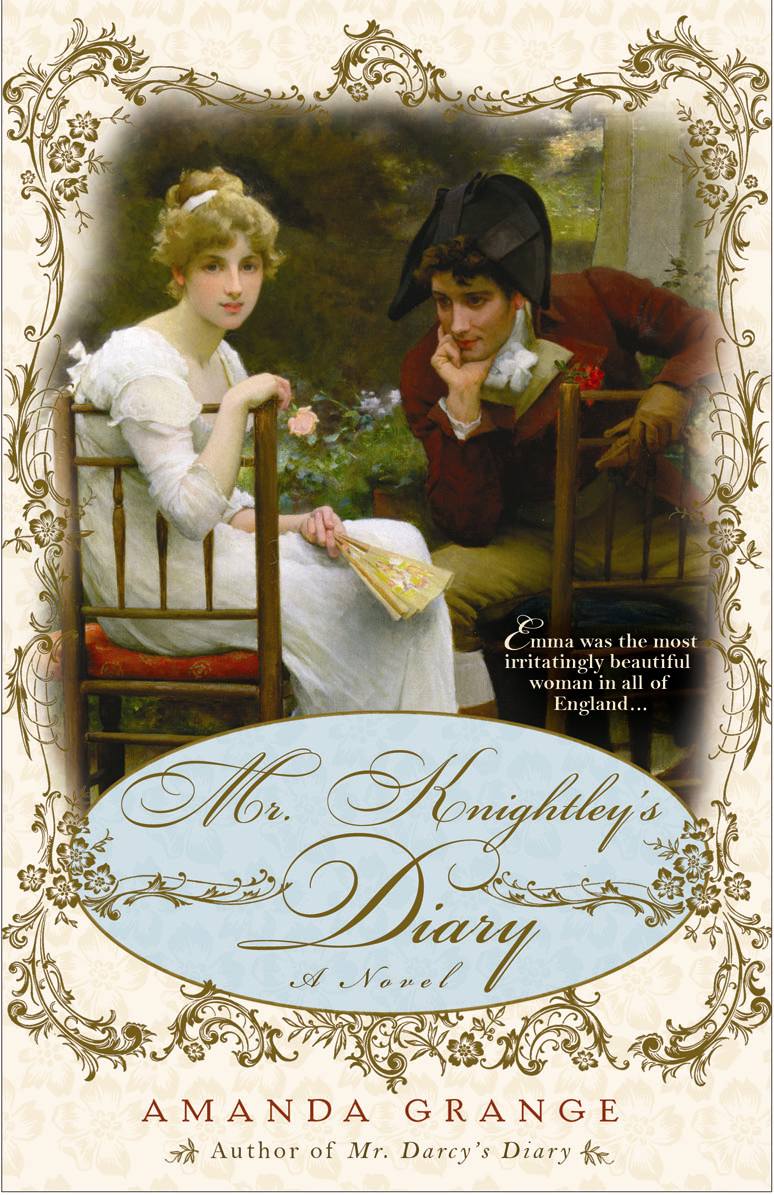
Austen's Heroes Series - Amanda Grange


If you're friends with me on Goodreads or Facebook, I think you've noticed that I've had a bit of an Amanda Grange binge this weekend, reading four of her six Austen's Heroes books in about four days. The books, retellings of the works of Jane Austen from the hero's point of view, are a quick and extremely fun read for someone currently working on her dissertation.

Depending on which edition of the book you find, each novel is only about 200-300 pages, all in diary format. I admit, I have a bit of a soft spot for diary format books. Not only are they always a much quicker read than their normal prose brothers, but they also give the character voice more depth and power because, essentially, you're reading the character's diary. It gives you insights into what they're thinking and the kind of things that one would only write assuming no one else is going to read it. It's a very personal read and very engaging.

The other delightful thing about these books is that, quite frankly, Amanda Grange is a lovely writer. Although no Jane Austen (but who is?), she writes these books as if you were sitting in the front room, doing your needlework and watching the proceedings. She slips into the Regency Period like she has experience in it (and for all we know, Grange might have a time machine). The books are meticulously researched and very well thought out. They are no disappointment to any Jane Austen fan.

My favorite part of the books, however, is that she doesn't limit herself to what is in the Austen original. Austen was writing from the woman's point of view and includes what's important for us to know about her. Well, Grange is writing about the men so she includes what's important for us to know about them. Her Persuasion rewrite, Captain Wentworth's Diary, begins eight years before the actual novel, exploring what happened in Anne and Fredrick's initial flirtation. The Northanger Abbey sister book, Henry Tilney's Diary, begins with his mother's death when he was sixteen, a scene that will become important later. Not only that, but it continues past the point of the original book, showing what hardships Catherine and Henry have to go through in order to get his father to accept them. It even explores just why his brother is the way he is.

And that's what's so great about these books. They not only retell the story with a different main character but they also get to tie up loose ends and character motivations that weren't explored in Austen's original. I consider the backstory about Henry Tilney's older brother basically canon because it explains so much about why he behaves in the book how he does. Colonel Brandon's Diary, the Sense and Sensibility accompaniment, pretty much changed my view of the book. We get a look into what Colonel Brandon's past was in the original novel but it's all in flashback. Here, it is presented with every twist and tragic turn. I even teared up at some parts. And now I know, although I used to consider Brandon a nice but ultimately boring hero, that he deserves his happiness at the end of the book. It honestly made me like Sense and Sensibility more. Before I only liked Elinor's story but now I can appreciate Marianne's more.

These books are like candy for an Austen fan. They're very sweet and you'll go through them quickly. If you're having a bad day or just need a pick me up, they're a perfect go to. I cannot recommend them highly enough.

Thursday, 28 June 2012

The Selection - Kiera Cass


This, my friends, is an extremely odd book. The combination of YA, dystopia and what is basically The Bachelor creates a book that seems like it should be bizarre but is oddly readable. I got curious about it when I was working at HarperCollins and it was going to be the big hot thing. Obviously interested, I grabbed a copy when I could get a chance.

The Selection takes place in an America of at least a few hundred years in the future. In this new land, the new prince of country must take his queen-to-be from one of the common people, an idea of uniting royalty and nation. These girls are picked from random from each of the remaining states and sent to live in the palace as they slowly get whittled down, reality show style. 

The other significant part of the plot is that, in this dystopian society, there is a sort of caste systems of Ones, Twos, Threes all the way down to Eights (the homeless). Each person is born into their caste and it's very hard to move in and out of them. The Threes and above pretty much have it made while the lower classes have to work very hard for food and the like. 

Our heroine, America Singer (I know), is a Five, the artist class, making her a (can you believe it?) singer. She earns her money performing at events and parties but is also in a family of seven, helping to earn their keep. Secretly, she is also in love with the boy next door who happens to be a Six (oh no!), the servant class and much below her. Not that our plucky America cares.

Now, obviously or this book would be quite short, America gets picked to represent her area in the Selection and is whisked away to the palace to court Prince Maxon (along with thirty four other girls.) Of course, she doesn't really care about winning the prince's heart so much as earning money for her family (there is a generous compensation awarded to the girls' families) and just eating some good meals at the palace. But when she actually gets on quite well with the prince, will she find that she might truly want this?

What I liked about this book is that it was more than it appeared. There are hints at an underground war being fought and secrets behind the government that could bring down the nation (there are no history textbooks, the subject only being taught orally and rarely.) I'm really quite intrigued to find out more about this country that Cass has created because it actually sounds interesting. 

Along with that, America is actually a quite likable character. Although I detest her name, her personality is well written and relatable. She's a good female lead, if I'm a bit annoyed with her random love affair with Aspen, the boy back home. She's plucky and high spirited but she also doesn't mind wearing a pretty dress once in a while. That's my kind of girl.

The character that I surprisingly liked the most, though, was Prince Maxon. He was adorable! Not used to women and clearly enjoying getting to spend time with a bunch of pretty girls (but in a little boy in a toy store way, not a letchy way), he just stands out as the one character that doesn't have an ulterior motive. He genuinely wants to find a wife (if not just a friend) and wants everyone to be happy. He may not be as dashing as Aspen but he was sweet and I liked him.

The Selection is not a book for those that hate the very idea of The Bachelor and such but it's definitely for someone that likes a good dystopia. It has girly elements but at its heart, it's a story of a messed up world and some young people that are just trying to find their place in it. I'm looking forward to the next one and think you should give it a try.


Friday, 13 May 2011

[034] The Deception - Catherine Coulter


The Deception by Catherine Coulter

What the Back of the Book Has to Say:

DEAR READER:

The Deception first appeared in April 1983 as a Signet Regency with the title An Intimate Deception. I've completely rewritten the story so that it's now a full-bodied historical romance. It has a brand-new beginning and a brand-new ending, and I've improved everything in-between to make it richer, bolder, more fun, and more adventurous. 

The Duke of Portsmouth offers an impecunious half-French relative a job as his young son's nanny. What he quickly discovers is that he wants her, badly. What he discovers far more slowly is that she isn't at all what she seems.

Evengeline de Beauchamps is in way over her head. She has far more to cope with than a nineteen-year-old virgin should ever have. To top it all off, she must play an experienced widow with a man who knows women as well as he knows his horses, or so he thinks. 

You'll see Phillip and Sabrina Mercerault from The Offer and hear more about the famous cat races of southern England.

Write me and let me know what you think of The Deception.

Catherine Coulter

Why I Picked It Up:

The Countess had been so deliciously ridiculous, I was so excited for a new one.

What I Think:

You all remember (or I hope you remember) the wonder and beauty of B-movie-esque novels that was The Countess. When I was wandering the library shelves and landed upon yet another Catherine Coulter book, with the same ridiculously dramatic cover and strange letter to the reader as a back cover, I might just have let out a tiny squeal of glee. It was like spring break had come early. I was pumped.

Did you read the back of the novel? "She has far more to cope with than a nineteen-year-old virgin should ever have"? "[You'll] hear more about the famous cat races of southern England"? This book promised nothing but amazingness. I can't even get across to you how excited I was about this.

The beginning of the novel was just as deliciously strange as it's predecessor. We found young Evengeline being attacked by some strange force in her apartments in France. Someone, a little unclear who, had kidnapped her father and was forcing her to act as an agent of some evil government. Of course, later it becomes pretty clear that she's working for rebel supporters of the deposed Napoleon. I guess, looking back, that's probably the only feasible evil agency to have attacked her but it begins in such a flurry of activity that you're more confused than scared for her. 

She ends up at the home of a distant relative (by marriage) in order to plead to let her stay with him. Of course, this is all under the secrecy so that she can usher French agents (and British traitors) into England at the nearby cove. The Duke of Portsmouth, meanwhile, is curious about this lady that has showed up and appoints her as governess of his son. 

Obviously, these two fall madly in love while she feels guilty about the deception (get it?!) that she's purporting as a French agent. The duke is somehow mixed up in  Napoleon's defeat in England, not to mention one of his good friends has recently been murdered in the war effort so there's just a whole bunch of nonsense going on. 

The most disappointing thing about this novel is that it is somehow not as ridiculous as The Countess. Sure, the plot is pretty dismal and there are some good scenes where Evangeline is trying to convince the duke that she's a widow with stories about her amazing deceased husband (that never was) but mostly, the plot follows a straight-foward angle and there's just not that sense of whimsy that came out of Coulter's early novel. I missed her rambles and unrelated anecdotes. I wanted some awkwardly placed comedy or overly dramatic declarations. It was all missing from this semi-serious romance.

We never even heard about the cat races! Don't tease me about cat races and don't deliver, Coulter!

Now, I'm not saying this book was good or anything. It was entertaining as the next romance novel.  It's just that what had set The Countess apart was that it was just so silly and this novel just couldn't be anything other than another, typical romance novel.

Tuesday, 18 January 2011

[010] Ever After - Wendy Loggia


Ever After by Wendy Loggia

What the Back of the Book Has to Say:

By the time Danielle is eight years old, her mother and father have died and she has been left in the care of her new stepmother, the Baroness Rodmilla of Ghent. Twelve years later, the baroness and her two daughters have made Danielle their servant, giving her the nickname Cindersoot and order her everyday to chop firewood, tend the grounds and clean the manor house.

When Prince Henry of France begins a search for a wife, the baroness intends to make sure her beautiful daughter Marguerite becomes his bride. But when Danielle and the prince meet by chance one day, sparks fly. The baroness will do everything within her power to keep her servant from becoming the Queen of France.

Based on the classic story of Cinderella by Charles Penault, Ever After is a historical romance that is certain to charm and delight modern readers.

Why I Picked It Up:

I honestly don't know.

What I Think:

Now, I can't say that I normally read novelizations of movies. It's a very strange genre of book. It's not quite a book because it is very obviously drawing upon another source and usually, if you're reading it in the first place, it's because you saw the movie. While some might see this as a drawback, I do have to say that there is one nice thing about them, one advantage that they have by simply being what they are. 

The novelization can draw upon a reader's prior knowledge of the plot and leave a lot of obvious information by the wayside to dig deeper. The reader knows who the characters are and why they're doing what they're doing; what they maybe don't know is what's driving a character, what their inner dialogue is during key points of the plot. This is a chance to make the movie more into a fleshed out story instead of a screenplay. 

Ever After did not do any of this.

The movie Ever After, if you aren't aware, is a historical romance retelling of the Cinderella story. The heroine is a plucky girl named Danielle (played by Drew Barrymore) who is an orphan living with her stepmother and two stepsisters who treat her like a servant. Despite all this, however, she tries to live happily, making friends with the servants, going into town, and eventually accidently meeting the prince and pretending to be a gentlewoman so she can continue hanging out with him. Leonardo Da Vinci is even a side character in all this tomfoolery and I could honestly not tell you why. 

The novel was a basic retelling of the story with lines lifted directly from the movie. After checking the Amazon reviews (always a hilarious thing to do with bad books), I found that, apparently, a lot of lines had been changed but to some sort of oddly worse interpretation. I didn't think that was possible. 

The author is a romance novelist for teens and it shows. Now, to be fair, I know I'm not really the target audience of this book but give a girl a break: even at thirteen, I think I would know drivel when I read it. The whole point of the movie is that it's a more modernist perspective on Cinderella, where Danielle is a stronger character and a personality to play off of the prince, rather than just wait for him to show up with a shoe. This is all thrown by the wayside in the novel, where Danielle is entranced by his dreamy looks, even if she does discuss a little bit of politics and Thomas More with him. 

The story is virtually identical in the movie (as, I suppose, it should be) so if you liked the movie, then you will probably not mind this book. It's a quick read; I think I read it in a day, on the train to work and then home again. If you're looking for something to take up an afternoon, then this could easily be it.

To be honest, I'm a little disappointed in myself. I loved this movie the first time I saw it when I was eleven. I watched it again at nineteen and realized that it was kind of crap. For some reason, however, I saw it at the library and thought "Oh, this could be good." I don't like the movie. Why did I pick it up? 

Saturday, 4 December 2010

[007] The Countess - Catherine Coulter


The Countess by Catherine Coulter

What the Back of the Book Has to Say: (and in this case, it's a hell of a lot)

Dear Reader,

The Countess was my very first novel, published in 1978 under the title The Autumn Countess. Even at that amazingly young age, I still realized I should write about something I knew. Since I'd grown up reading Georgette Heyer and my master's degree is in nineteenth-century European history, it wasn't much of a mental stretch--a Regency romance. Well, sort of.

As it turned out, The Autumn Countess danced into the bookstores not as a Regency, but as a Gothic masquerading as a Regency.

I've rewritten the novel extensively to make it even more unabashedly Gothic in form, texture, and content, including use of the first-person narrator in the classic Gothic style.

Andrea Jameson, unlike the conventional Gothic heroine, isn't a destitute governess. She's young, rich, and toothsome, and adores her Dandie Dinmont terrier, George. However, Andrea doesn't have a single dream of meeting Mr. Right, marrying, and living happily ever after. Go figure.

She strikes a bargain with an older widowed earl who promises her all the razzle-dazzle without the obey part. She's perfectly happy with the deal until she meets the earl's nephew and realizes fairly quickly that she might have made an exceptional blunder. 

But she doesn't have much time to ponder her dim-witted choice of husband because someone is trying to kill her. Will she survive to marry the man of her dreams? 

I hope you enjoy the inside cover. The art department had a ball designing what they call their "uptown classic Gothic." 

Do tell me if you enjoyed the rebirth of my Gothic tale.

Catherine Coulter
Write me at PO Box 17, Mill Valley CA 94942

Why I Picked It Up:

It had been a long time since I'd read a romance novel and it looked to be one of the few, if the only, on the shelf.

What I Think:

Romance novels and I have a long and colorful history. It all began when I entered college and quickly became an English major. For a majority of my college life, I also lived with two other English majors, the aforementioned A and another roommate who we will call V. It didn't take long for the three of us to discover that reading very serious literature all the time was rather tiring for the brain and although we loved reading enough to major in it, we did not love it so much as to read heavy things in our free time. And thus, we discovered romance novels, Regency romance novels in particular.

Regency romance novels are beautiful in their formulaic-ness . They all proceed in about the same fashion: young virgin meets slightly older (probably titled) man with a flawed and most likely tragic past, the two fall in love and will have to overcome some sort of evil villain or dangerous plot or just society in general that stands in the way of their happiness which, of course, they will. The woman will probably better her social status and the once nefarious rake will finally settle down, most likely with the birth of their child in the epilogue. You pick up the book knowing there will be a happy ending, after a few adventures and roughly three sex scenes, varying in graphicness. 

To be quite honest, despite trading romance novels around in our suite like a mini-library, when I ended up not living with the two of them my senior year of college, I fell out of the routine of the romance novel. They still have not lost their appeal but without others to laugh at it with and tell that "you have to read this one next," it's just not the same.

Perhaps nostalgia for a sillier time is what prompted me to pick up The Countess. If you gave even a half glance to what the back of the book had to tell me, I think you have a pretty good idea of what was going to happen in the book as well as the quite ridiculous writing style I was going to have to put up with. This book can ramble like nobody's business and enjoys going off on tangents that seem unnecessary (and, well, are). It takes itself very seriously (as it's a "Gothic novel" after all) and that is why I have put it in the 'so bad, it's good' category.

The Countess is like a stupendous B movie. First of all, it thinks it is a Gothic novel which, I can tell you quite plainly, it isn't. Apparently, to be a Gothic novel, you just need a dusty castle and a ghost. Admittedly, The Countess has both of those but those two traits alone do not a classic Gothic make. The whole thing stinks of an author who has read too many romance novels (along with real literature) herself and was very self-satisfied with her own attempt, despite the fact that it really isn't what she thinks it is. Which, I suppose, I should take as a warning should I attempt to write my own some day.

The best thing about this whole, ridiculous novel, however, is that despite the fact that you can tell on the back cover what the entire plot of the novel is, she still throws in more plot twists than you can shake a stick at, just to confuse the hell out of you. If you read the back of the book, you know already that person who is "trying to kill her" has to be the husband she married or else there is no feasible way to pull off the happy ending prescribed of her marrying this nephew of his. It would just not work in romance novel logic, especially as a Regency book. Putting all that aside, though, Coulter has thrown in side-stories about ghosts, some sort of terrible past the heroine has with her father which will coincide with her staying pure (another thing a Regency heroine needs is purity, since one plot point of the story will be her finally sleeping with the true love of her life, in this case the nephew), a brother and sister-in-law who are either sinister or just kind of strange, a society rival (despite the fact that their castle is in the middle of nowhere) and just general danger and mayhem. It's an awful lot for this tiny book to carry and most of the time, it flounders under too much plot.

Despite all this, I still genuinely enjoyed The Countess because it was just all so silly. Coulter's writing style is bizarre, full of out of place language and asides that don't mean anything. The plot doesn't make sense at the best of times and is vaguely offensive at the worst. All in all, though, it is silly, ridiculous fun and a nice relaxing break from the depressing speculative fiction of Never Let Me Go.

After I finished it, I talked to A on Skype and spent two hours recounting the entire plot to her, including as many quotes as I could find flipping through the book. I think I can say with complete honesty that both A and I give The Countess two bemused thumbs up.